The Bride with White Hair
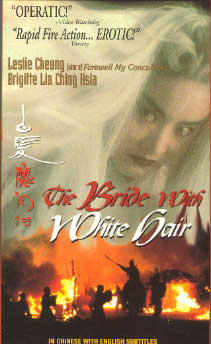
Reviewed by YTSL
This winner of the Grand Prize at the Fantastica
film festival in Paris is one of the most visually striking and astounding
movies to have come out of Hong Kong. Its sets and costumes come across
as works of art. The choice and use of colors is inspired and sophisticated.
This fantasy mood piece also possesses a most enthralling musical score (It
is, frankly, a travesty that no soundtrack album has apparently ever been
issued as a film tie-in and that only a limited number of photo books were
published).
Along with a top notch crew (of whom art director
Eddie Ma, cinematographer Peter Pao, composer Richard Yuen and costume designer
Emi Wada definitely deserve mention), director Ronnie Yu is also blessed
by having his cast led by the bewitching Brigitte Lin Ching-Hsia and Leslie
Cheung. This duo's performances ensure that there is soul and depth
as well as style to THE BRIDE WITH WHITE HAIR. It is they who
make one believe in and feel for their larger-than-life characters and the(ir)
highly dramatic story.
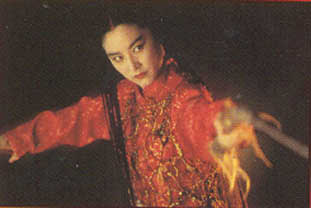
The tale itself is a familiar one of two star-crossed lovers a la "Romeo
and Juliet" and "The (Butterfly) Lovers" (both of which have been made
into more than one movie). The variation here lies in the protagonists
being: A fierce, whip-wielding woman who, for some time, had been the
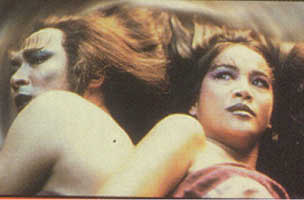
number one killing machine of a cult led by an outcast pair of Siamese twins
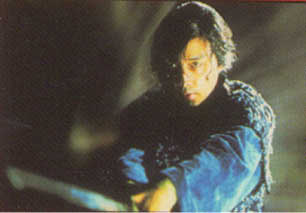
(who come in the form of Francis Ng and Elaine Lui); and a reluctant heir
to a powerful alliance of eight mainstream martial clans. Complications
come from the imperial Chinese government ordering the clans to go to war
against the kind of unorthodox sects that are threatening the country from
within and the Siamese twins actually being banished members of the clans
on which they seek revenge. Other obstacles to the love between Cho
Yi-Hang (Leslie Cheung) and Lien Ni-Chang (Brigitte Lin), the formerly nameless
wolf-girl -- really! -- who happily had one bestowed on her by Yi Hang, include:
An ambitious clan rival of Yi Hang's coveting the man as well as his position;
and the male half of the Siamese twins salivating after Ni-Chang even as
the female half mocks her brother for doing so.
Among the other things that sets apart that which has been described by many
as "an adult fairy tale" is that the two protagonists ARE adults (unlike
the youthful Romeo, Juliet, Ying-Toi and Tsan-Pak); albeit those whose first
glimpse of each other came when the flute-playing girl called a pack of wolves
away from a boy who had been trying to do a good deed by rescuing a goat.
Other "adult" elements evident in this movie have prompted the authors of
"Sex and Zen & A Bullet in the Head" to describe it as "darker and more
erotic than most" (Hammond and Wilkins, 1996:17). Above all, what distinguishes
THE BRIDE WITH WHITE HAIR for me -- as well as underlies its maturity --
is its emphasizing that trust is as important as mutual attraction, passion
and sacrifice in intimate relationships.
Lest it be thought otherwise, I would like to
make clear that this romantic tragedy is not at all without elements and
moments of humor, charm, swashbuckling action and fancy. Still, I would
caution that there are portions of the movie that lose their potency if one
were to see humor rather than drama in them. I (also) must admit to
feeling that the film's finale would have benefited from less bouncing off
walls and columns and other manic action. Even so, this is a very fine
production, which has made -- and will undoubtedly continue to make -- many
Hong Kong movie fans of its viewers.
N.B. The latest Tai Seng release of THE BRIDE WITH WHITE HAIR comes with
a very interesting "making of" documentary that ought not to be missed as
well as larger and clearer subtitles.
My rating for the film: 9.