Year:
1943
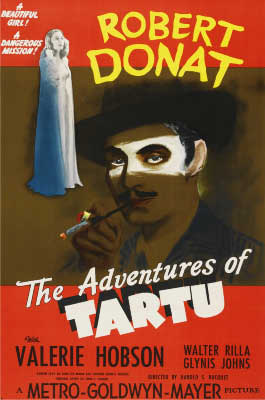
Rating: 7.0A fine piece of British propaganda in 1943.
It took that to get Robert Donat back on the screen. Donat was always a reluctant
film star and after winning the Academy Award for Best Actor in 1939 for
Goodbye, Mr. Chips against the stiff competition of Olivier, Gable and Stewart,
he took a break from film and focused on the stage. The two films he made
during the war were both propaganda films, The Young Mr. Pitt (in which he
gives a speech of Churchill's) and this film. He remained in England during
the war often on stage in London.
This film begins during the London Blitz
in 1940 and was shot in a real part of London after being bombed. He plays
Captain Terrence Stevenson, a bomb defusal expert. In that Donat charming
manner, he defuses a dropped bomb and also calms an injured boy and his nurse
at the same time. He is called in for a mission. Take on the identity of
Tartu, a man in the Romanian Iron Guard (a fascist group) who is dead, get
into Czechoslovakia, infiltrate a chemical plant producing poison gas, learn
the formula and blow up the plant. What could be easier.
But it is Donat and he is smoother than
polished glass; transitioning from one personality to another to accomplish
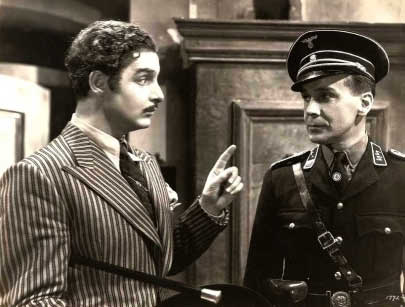
his mission. At one moment an oily Lothario, in the next a rigid Nazi doing
Heil Hitlers and then deadly serious. It is a terrific performance from him.
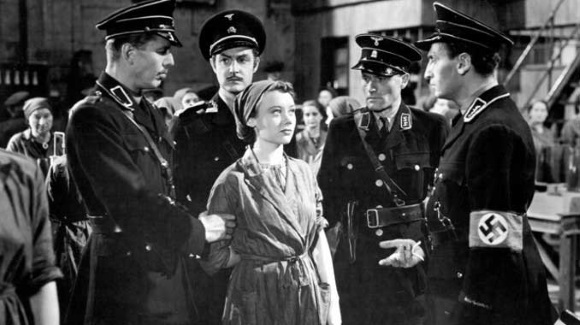
He settles into a house inhabited by a young female working in a bomb factory
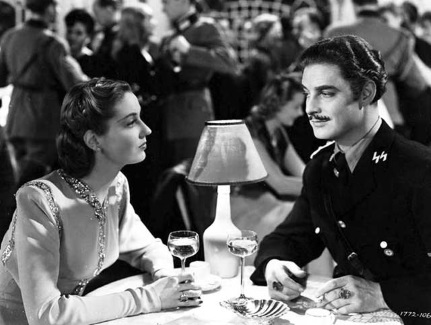
(the great Glynis Johns), a Nazi officer (Walter Rilla), an elderly landlady
(Phyllis Morris) and an aristocratic Czech (Valerie Hobson). Rilla had been
in the Communist Party in Germany and had escaped to England in 1936 and
was to play Nazis multiple times in his career. Most of the characters are
not quite what they seem. In an interesting twist, the Underground thinks
they need to kill Tartu, not knowing who he really is. Some solid suspense
as the Nazis close in on Donat, a romance of course thrown in there, but
Donat commands the screen.