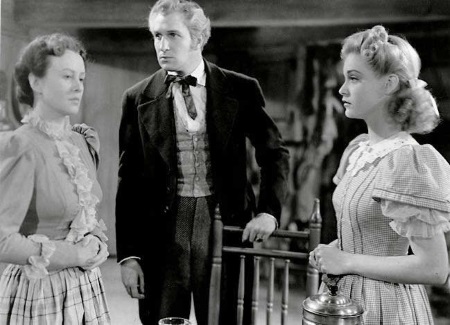
The House of the Seven Gables
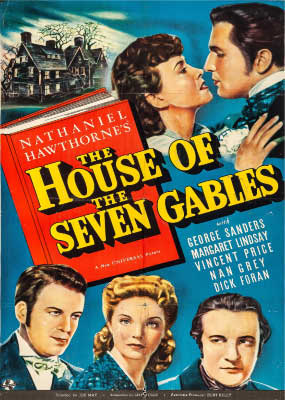
Director:
Joe May
Year: 1940
Rating: 6.0
This film is often lumped into the Universal
horror bucket as a Gothic horror, but it is much more a Gothic melodrama
and a fairly effective one. For a few years in the late 1930s Universal had
gotten out of the horror business, but the success of the revived twin bill
of Frankenstein and Dracula pushed them back in and they were to produce
a series of mainly B horror films during the 1940s. This was certainly intended
to be a B film with elements of horror based on a novel in the public domain
and a setting that nearly all takes place in a house. One designed on the
real house that the author of the book, Nathaniel Hawthorne, based his story
on. But the design, fine acting, intelligent script, wonderful ageing make-up
and shadowy claustrophobic cinematography make it look and feel like more
than a B film.
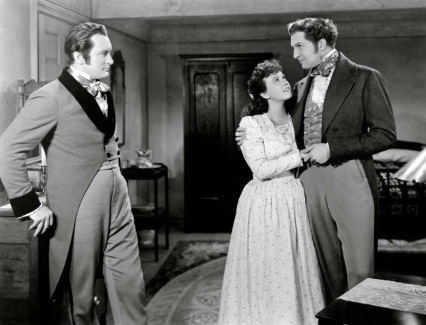
Much of this may be due to director Joe
May. May had been one of the major producers and directors in Germany during
the Weimar Republic. In 1933 when Hitler was elected, he wisely left for
Hollywood where Universal hired him. He never achieved the success though
that he had in Germany. His thick accent was an issue on the set and apparently
George Sanders lived up to his reputation as being a jerk to May and everyone
else. Perhaps he was just staying in his character. His co-star Vincent Price
said Sanders wasn't as awful as people thought. But the two of them did not
get along. So a solid cast with Sanders as his often-haughty insulting character
that he did so well, Price very early in his career and well before becoming
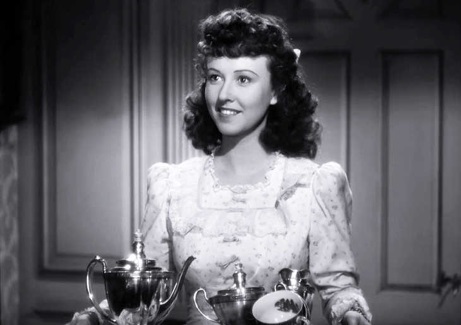
a horror icon and the wonderfully underrated Margaret Lindsay. She is always
so good and attractive but mainly got stuck in B films, some suggest because
of her open liking of women. She is great here.
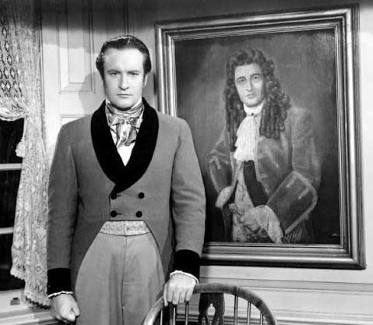
The film opens as does the novel with a
brief backstory related on a few pages of text. The House of the Seven Gables
is cursed. Over a hundred years earlier, Pyncheon had a man accused of witchcraft
and after he was hanged, bought his land and built the house on it, but not
before being cursed by Matthew Maule. 120 years later in the early 1800s,
the family has fallen on hard times. The father and his son, Jaffrey (Sanders)
have made poor investments, and the family is deeply in debt. The father
has decided that the house must be sold which sends Jaffrey into a fury but
pleases the other son Clifford (Price) who wants to move to NYC to be a songwriter
and take his cousin Hepzibah (Lindsay) that he loves with him. But Jaffrey
persuades the father to change his mind, and this causes a huge argument
between the father and Clifford that causes the father to have an apoplectic
attack and die. The curse.
Jaffrey accuses Clifford of killing him.
Murder he yells. The film takes place over a period of twenty years, Lindsay
ages appropriately, the other two to a lesser degree. It unexpectedly turns
into a deep love story. Two of them and the curse. From what I have read,
other than that beginning and the characters, this has little resemblance
to the book. In that Clifford is the brother of Hepzibah and becomes a near
idiot. The writers also injected some political ideology into the script
by including abolitionists into the story, a speech for freedom of expression
and making greed the real villain. Not totally surprising in that the writer
Lester Cole was a member of the Communist Party and was jailed as one of
the Hollywood Ten and blacklisted. The lovely Nan Grey also appears as a
cousin to live in the house.