The Quatermass Xperiment (1955) - 8/.0
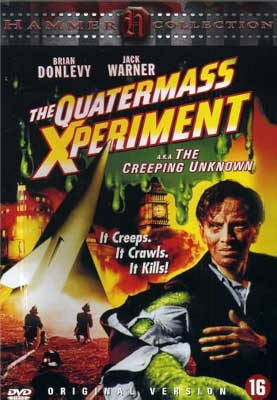
Hammer was still finding its way in 1955,
moving slowly from cop and noir films to sci-fi and then horror. It had some
success with Four Sided Triangle and Spaceways in 1953 and so were open to
getting the rights to the popular BBC production of the six-part Quatermass
Xperiment written by Nigel Kneale. BBC was not enthusiastic about a B film
studio making the film, but no other studio was interested. Hammer chose
Val Guest to direct. A lucky choice because none of his previous films were
more than mid-budget crime and comedies. He was to go on though to direct
Quatermass 2, The Abominable Snowman, The Day the Earth Caught Fire and When
Dinosaurs Ruled the Earth. He does a terrific job here of melding the disparate
elements together. Alien, horror, police manhunt and mutation all mingled
together in a very satisfying result. At the time, space was still a mystery
of unknowns to the public and this plays wonderfully well on fears and paranoia.
The film moves briskly with no down time and had moments that feel influenced
by Hitchcock (the silent scream, the little girl (Jane Asher) with a doll
and the old lady in the police station) and the Jacques Tourneur RKO horror
films (the zoo scene).
At this time, Hammer often co-produced their
films with the American company Lippert Productions. Lippert always demanded
an American actor as the lead, but due to budget constraints, they only got
actors who were past their sell date in Hollywood. In previous films there
was Howard Duff, John Ireland, Richard Conte and Dan Duryea. All fine actors,
but at a point in their careers where they were willing to go to England
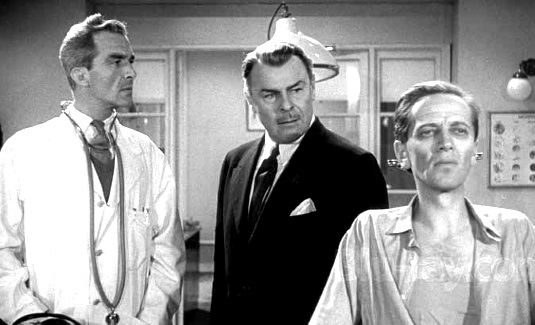
on a B pict. This time it is Brian Donlevy. Donlevy was a solid star back
in the 1940s usually playing tough ruffians in Westerns and crime films.
I don't know if it was intentional but as Quatermass he is the perfect Ugly
American. A bull in a tea shop. Rude, curt, demanding, he overwhelms everyone,
listening to no one. At one point, he tells the wife of the astronaut, "There
is no room for personal feelings in science". He very much symbolizes America
in the 1950s telling nations what to do. He is a complete prick here right
to the end as he walks alone down a dark street. He barks more than he acts.
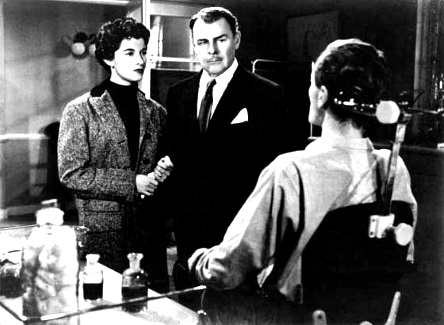
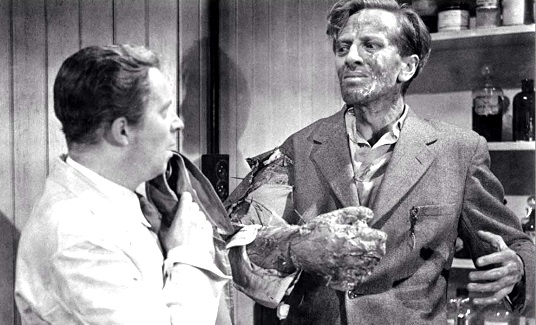
Three astronauts go into outer space on
a ship that Quatermass built. When it crashlands in England, only one astronaut
is in the capsule. The other two impossibly vanished. The surviving astronaut,
Carroon, is in a near catatonic trance, unable to talk, only stare. He is
played with incredible pathos by Richard Wordsworth only with his pleading
eyes as he realizes what he is turning into. A monster. A terrifying mass
of goo that could destroy the world if it produces spores. The film was a
big hit and created a Quatermass franchise. Sadly, the original BBC TV production
is mainly lost, but apparently in it Quatermass talks the man/monster into
dying. Not good enough for a movie, of course.. Shot in black and white.
The success really sent Hammer into the world of the fantastic. Frankenstein
was a year later. This holds up very well some 70 years later.
Quatermass II
(1957) - 7.0
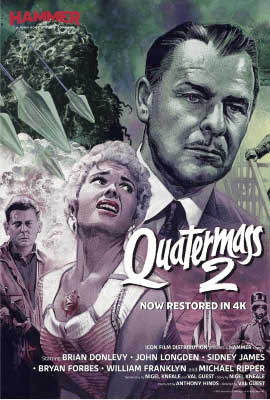
By 1957, the cinematic skies were filled
with alien invasions and alien possession. The Invasion of the Body Snatchers
was released in this same year. Paranoia was in full swing in the Western
world due to the fear of Communist indoctrination. Here it is portrayed as
an infection that takes away the will and personality of people. BBC produced
a follow up mini-series to the very successful first one and Hammer again
bought the rights to it. The mini-series was again written by Nigel Kneale,
but this time around he was involved in the script for the film. He hadn't
really liked the first film; in particular Brian Donlevy's portrayal of Quatermass.
Many agreed with him, but the director of both films, Val Guest, thought
Donlevy was terrific. So Donlevy is back frustrating Kneale who thought he
was often inebriated on the set. With Donlevy, it is hard to say. Subtlety
was never part of his acting sklls. He isn't quite as annoying as the Ugly
American this time, but he is constantly rude and impatient with everyone.
But then he does save the world. So there is that. Yay America!
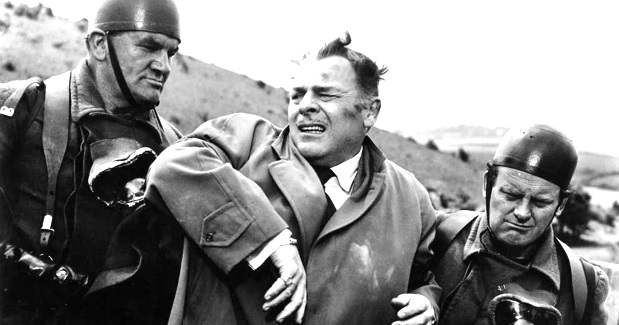
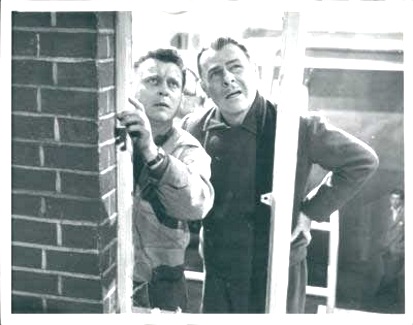
Quatermass is in a lousy mood as always
- a smile would break his face - a laugh would cause a hernia - because the
British government has refused to fund his plan for a moon base, one suspiciously
similar to what Elon Musk is planning. One of his men informs him that objects
have been falling from the sky in this small area. He goes to take a look
with a colleague and finds a base that looks just like his moon base model.
The colleague picks up one of the small objects and it explodes in his face
leaving a black parasite on his face and the armed guards show up, take in
his friend and chase Quartermass out
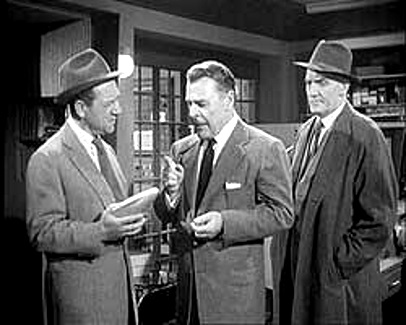
Quatermass doesn't play that game and goes
to London to get help. The government may have been infiltrated as well.
The Inspector from the last film (different actor - this time John Longden
who had been the male lead in Hitchcock's Blackmail in 1929) joins him as
does a journalist (Sid James). With a nearby pub full of angry drinkers,
they invade the base. This is a bigger film with what seems a larger budget
than the first one. It misses that personal touch of the one man tragically
turning into an alien creature. The humans turned alien here have no personality
and so when they are killed you feel nothing. Still, the film is driven by
Quatermass at full speed like a pitbull with no time for others and that
pacing keeps the narrative tense and exciting. Michael Ripper is on hand
as the barman and fighter. The film was a big success and led to a sequel
. . . ten years later. Part of the reason it took so long was another film
released in this same year; The Curse of Frankenstein which was to change
everything in the World of Hammer.
Quatermass and
the Pit (1967) - 8.0
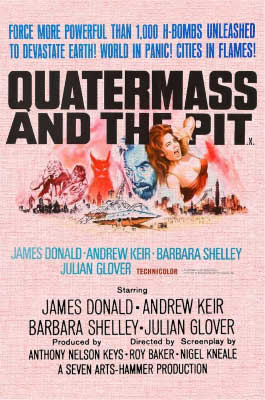
Wow. What an astonishing ending.
Gripping and terrifying. I am surprised that I had never seen this. In fact,
I hadn't seen the second in the Quatermass series either. All three are very
good, all from the inventive mind of writer Nigel Kneale. All three quite
different from one another centering around the character of the scientist,
Professor Quatermass, who keeps saving the earth from aliens but apparently
gets no credit or recognition for it. Quatermass Xperiment is very good,
Quatermass II is very solid and this one is brilliant. The idea behind it
feels very original as the earth is threatened again, but not how one might
expect.
It is surprising that the third film didn't
come out till ten years after the second one. Both previous films had been
quite successful at the box office, but so was The Curse of Frankenstein.
Hammer was to turn to recreating the Universal horror figures of Frankenstein,
Dracula, the Wolfman, the Phantom of the Opera and the Mummy and turn away
from sci-fi. BBC had produced another Quatermass mini-series from Kneale
in 1958 and again Hammer purchased the rights to it. It was to again to star
Brian Donlevy as Quatermass, but Hammer was unable to get the funding from
Columbia as they normally did. So, they mothballed the script and I guess
Donlevy was too busy this time around. Instead, they hired Scottish actor
Andrew Keir which no doubt made Kneale happy as he couldn't stand Donlevy.
Keir is perfect for the role; smart, caring, intellectual and very professorial.
The opposite of Donlevy. The film is in no rush to get to the dramatic parts.
It slowly but methodically builds to it increasing the tension and mystery
bit by bit till it explodes in manic chaos.
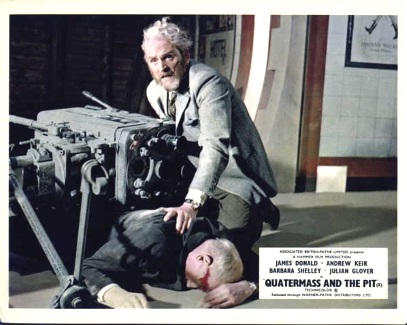
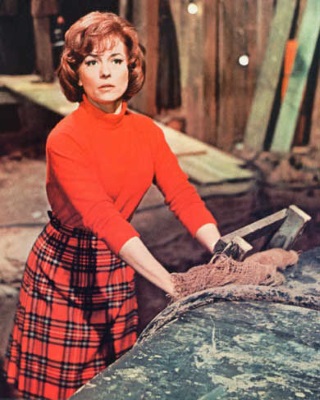
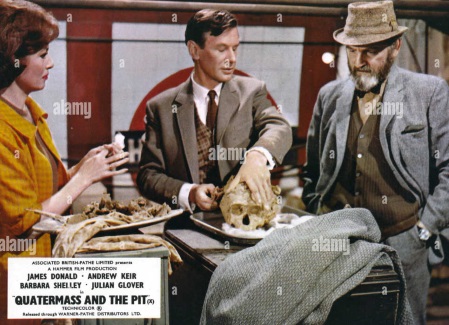
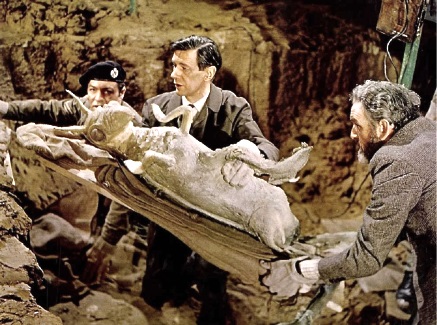
In excavating a subway station, the workers
come across a number of skulls and bring in expert Roney (James Donald) and
his secretary Barbara (Barbara Shelley) to determine the age. Millions of
years they conclude. Then they uncover a large spherical metal object impervious
to heat. Quatermass enters the picture. He is at odds with the military that
want to turn future moon bases into a station with missiles. The military
and the government bureaucracy are the real villains of the film. It goes
along slowly, the military pushing back on Quaterman's theory of where the
sphere came from. It almost at times feels like an episode of the X-files
as Quatermass and Barbara investigate strange occurrences in the area going
back decades.
Then the film jumps into a frenzy of insanity.
There are a couple brilliant scenes all on top of each other. Shelley in
particular is magnificent in the climax simply with her expressions and it
is no wonder that director Roy Ward Baker said that he fell in love with
her. This was to be the final Hammer Quartermass film though there was a
1979 TV mini-series titled Quartermass starring John Mills. It too was scripted
by Kneale, but I only vaguely recall watching it and not liking it very much.
I should give it another go.