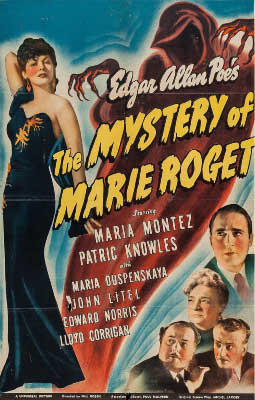
In Edgar Allen
Poe's short story, The Mystery of Marie Roget, he brings back his character
C. Auguste Dupin. In an earlier story, Dupin had solved The Murders in the
Rue Morgue. Dupin is credited as being the first fictional detective though
the concept of a professional detective did not exist at the time. Arthur
Conan Doyle admits to the influence of Dupin on Sherlock Holmes and from
that stems the entire genre of detective literature. Dupin was to appear
in one more short story, The Purloined Letter. Marie Roget was based on a
true crime, the murder of a young woman in New York City. In this story,
Poe is nearly meticulously trying to solve that case, but the murderer was
never found. He moves the murder to Paris and changes the names. In his story,
a woman's body is found dead floating in the Seine and after weeks, it has
remained unsolved. The police ask Dupin for his help. Dupin solves it as
an armchair detective - reading the newspaper and police reports and using
logic. It is not the easiest Poe story to get through.
Of course, an armchair detective does not
make for exciting cinema, so Universal takes the kernel of Poe's story and
turns it on its head. Poe is used to that. Nearly all the adaptations of
his work gets mangled in the transition to the screen. This is a B film all
the way coming in at 60-minutes. Though Universal did their best to market
this as a fiendishly horrific murder case, it is really just your basic B
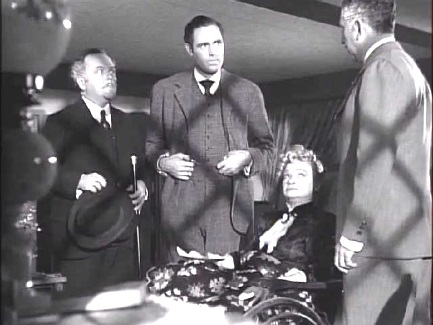
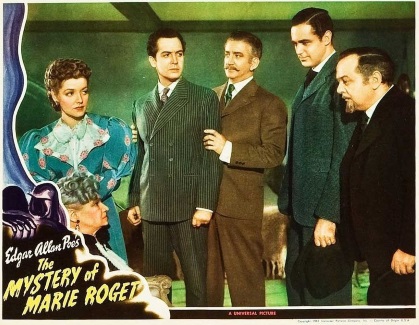
murder mystery and one that makes little sense. Dupin played by Patric Knowles
is the medical examiner for the police - thus allowing him to get out of
his apartment into the streets of Paris. Dupin as an action hero and possibly
romantic as well. He has gained a reputation for the Rue Morgue murders and
the Prefect of Police (Lloyd Corrigan) has come to depend on him. Like nearly
all police movie characters of the time, he isn't the brightest guy on the
scene.
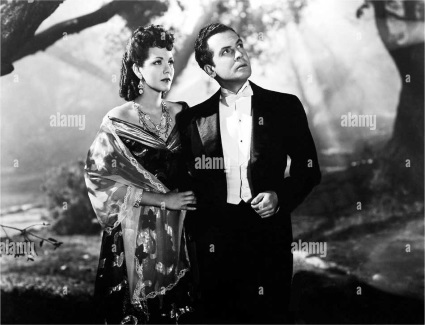
Roget is played by Maria Montez who soon
was to achieve stardom as the Technicolor Queen in a series of exotic adventure
films. But she is in black and white here and though billed after Knowles
doesn't get much screen time. Because she is Marie Roget. The murder victim.
She and the fiancé of her sister (Nell O'Day) are secret lovers and
planning to kill the sister who is about to inherit a fortune. Instead, Roget
is murdered and it is up to Dupin to solve it. None of it makes much sense.
One interesting oddity is that when the police search for Roget's body in
the Seine, they fire cannons off in hopes that the vibrations will bring
up the body. This is mentioned in the short story and I Googled it. Sure
enough, this method was a real thing and in Twain's Huckleberry Finn they
do it in search for his body. It doesn't actually work. Also, in the film
is the great Maria Ouspenskaya who was a famous acting teacher and late in
her life appeared in films and was nominated for two Supporting Actress Oscars.