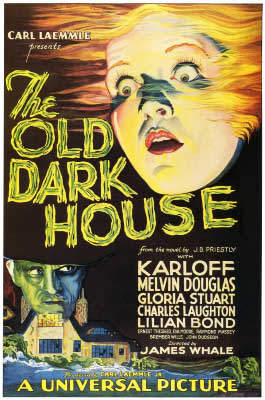
With Frankenstein,
director James Whale had astonished the cinematic world with his boldness
and creativity. And though he also was successful with his other horror films,
The Invisible Man and The Bride of Frankenstein, it was really drama that
attracted him. Before Frankenstein, his first film for Universal was the tragic
melodrama Waterloo Bridge and during the 1930s he was to return to drama
consistently. Needless to say, they never did as well at the box office as
did his horror films. After one such lackluster drama, Universal was thrilled
to have Whale back to horror with this film. Or is it?
Whale could certainly have sold it as such.
A large dilapidated gloomy house with staircase upon staircase, distorted
mirrors, home to an eccentric mad family, a group of strangers driven by the
rain stopping there and Boris Karloff. Karloff and been in a number of films
since Frankenstein but in small parts that made no impact. They wanted to
have him in another horror. In a producer's note at the beginning of the film,
they point out that the actor who plays the "mad butler" in this film is
the same as who played the "mechanical monster" in Frankenstein. Much of
this film sounds familiar today as many movies were to use these same ingredients
for many horror films. But not at the time other than a couple silent films
such as The Cat and the Canary and The Fall of the House of Usher. Whale,
who was a big fan of Paul Leni's Expressionism in his directed silent horrors,
makes great use of the house, the darkness, the flickering lights, the angles
to create a background of slow building dread.
Whale adapted this from a novel by J.B.
Priestly, one of the more prominent leftist writers of that period. Apparently,
there were a lot of class dynamics in the book, but for the most part Whale
and his scriptwriter dropped much of that. Still, this is very dialogue heavy
and the horror doesn't truly kick in until with about 20-minutes remaining.
Till then it is an actor's film with everyone getting a sizable chunk of dialogue
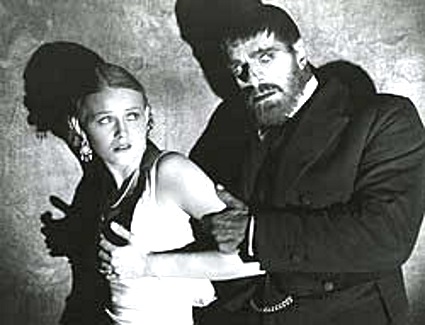
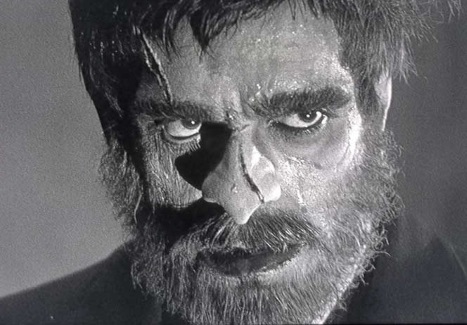
and their moment in the spotlight. Except poor Karloff who plays a maniacal
mute and was not really happy with that role. But what a set of actors, mainly
from the English stage. All but Karloff early in their film careers and a
few who would go on to great things.
Playing the jittery head of the house,
Ernest Thesiger was to become better known in The Bride of Frankenstein.
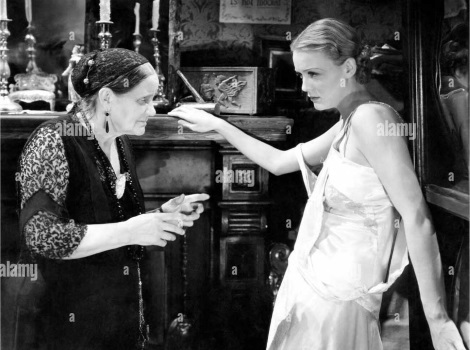
His religious fanatic sister played by Eva Moore was a theater star and nearly
steals the film. To her brother, "You are afraid. You don't believe in God,
but you are afraid to die". The first of the three strangers to arrive are
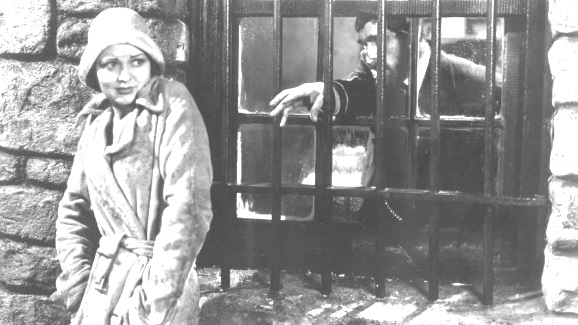
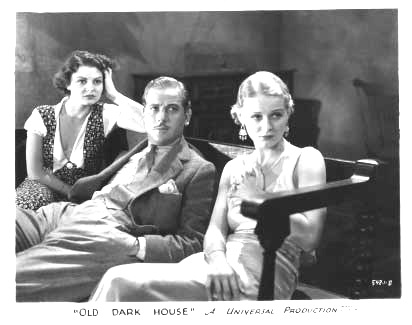
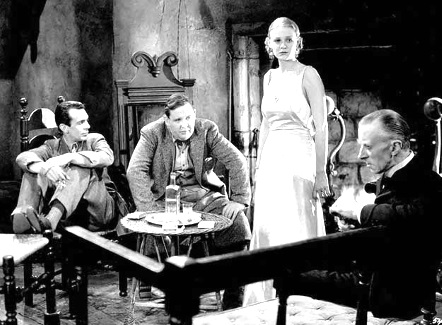
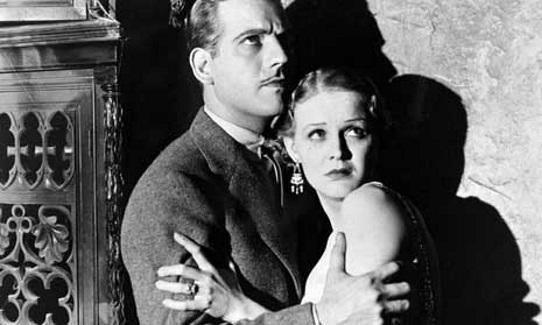
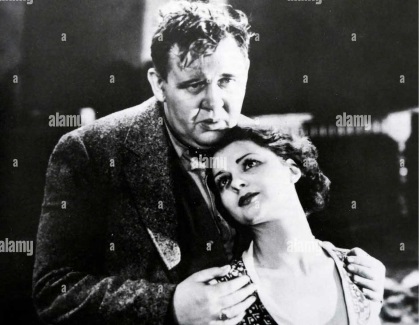
played by Raymond Massey, Melvyn Douglas and Gloria Stuart. Next come a pair
played by Charles Laughton and Lilian Bond. It is a delight watching them
trade barbs, niceties, flirtations and concerns as the night gets crazier
with a drunk homicidal Karloff and a psychopath in the attic.
But getting back to my original question,
is this a horror film? Well yes, and no. Whales is not really out to scare
the audience as much as to create a stultifying no escape atmosphere and a
situation in which five very different people have to band together to survive
the long night. And somehow, he squeezes in a bit of comedy and a love story.
We are lucky that this film still exists. After Universe lost the rights
to the book, they withdrew the film from circulation and lost it. For years.
Director Curtis Harrington went in search for it and Universal eventually
came up with a ragtag print that was restored.