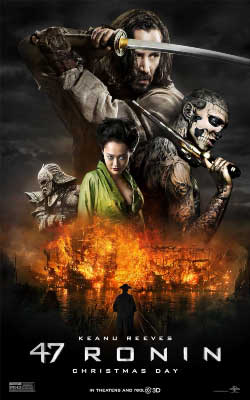
47 Ronin
                                      

Director: Carl Rinsch
Year: 2013
Rating: 7.0
The Ako Incident that took place on January 31, 1703 is one of the most famous historical events in Japan that still resonates with them over three hundred years later. It represents their wished for inner character - honorable, sacrificial, courageous, loyal and patient. It may seem like an entirely different age from today's salary men, but this is still their ideal. The Daimyo Asano was insulted by a court official named Kira Yoshinaka and he drew a blade and cut him. This was absolutely forbidden to do within the property of the Shogun and Asano was ordered to kill himself - seppuku - and had his lands confiscated and his Samurai became masterless Ronin. 47 of them. The leader of the Ronin, Oishi, waited a year and then planned a brilliant attack on the castle of Kira and murdered him. They then took his head and placed it on the grave of their Lord, turned themselves in to the Shogun and were ordered to commit seppuku as well. On March 20th, 1703 they all killed themselves together and were buried with their Lord. And went into history as heroes. Nearly from the beginning stories, plays and later films were made about them. These films and literature are termed Chusingura. In 2013 Hollywood decided to make their version of the 47 Ronin which actually follows the historical incident fairly closely with two tiny, teeny changes that only a historical scholar would notice.


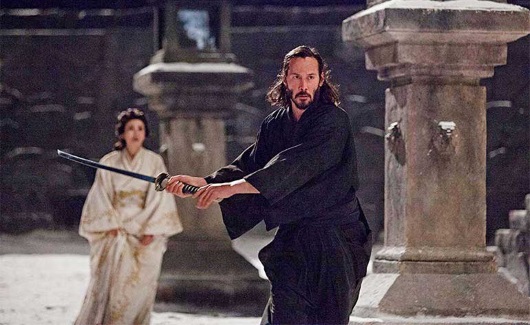
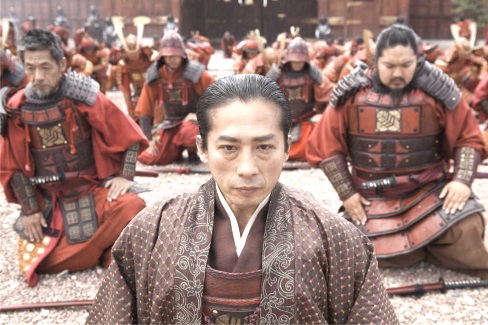
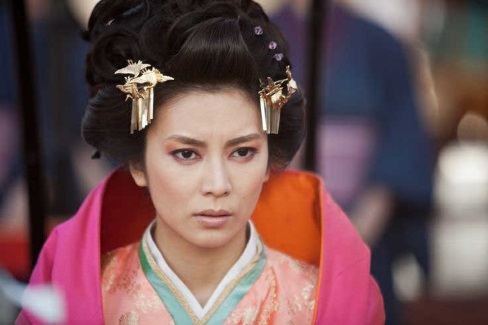
They introduce a supernatural element - a witch, demons, a troll and a mammoth animal - and what they term a "half-breed" - Japanese mother, western father - in the figure of Keanu Reeves. And he saves the day, saves the Princess, kills the dragon. Other than that though, this is a reasonably true telling. Or as close as films get these days. Obviously, this got a lot of criticism for introducing a white actor into the film - a made up one - and characters who all speak in English. But if you can put that aside, and that is a big if I see by reviews, this is a fairly entertaining film. High production values, some clever fun fantasy aspects and a topnotch Japanese cast. Only Sonny Chiba was missing. Among them are Hiroyuki Sanada, Tadanobu Asano, Kô Shibasaki, Rinko Kikuchi - all big stars in Japan and then Cary-Hiroyuki Tagawa as the Shogun. Great sets, large cast, beautiful women, some terrific action and one of the great stories of history.


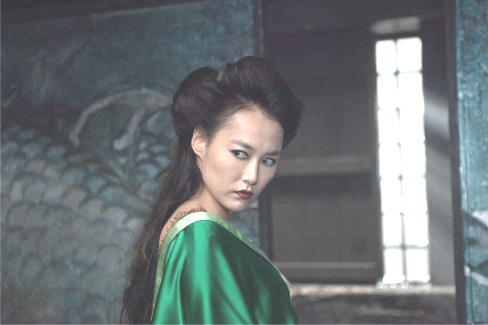
Kai is a young boy found in the woods - a half-breed - and the Japanese first instinct is to kill him - for his racial impurity but also because he might be a demon. But the Lord Asano (Min Tanaka) spares his life and Kai becomes a servant, thankful and loyal to his master - and good friends with Asano's daughter Mika (Kô Shibasaki) that as they become older turns to love. But clearly the status difference makes that impossible. All the Samurai hate him. But then the incidents that I have related begin to take place - in a clever power play, a witch in love with Kiri (Tadanobu Asano) causes Lord Asano to hallucinate and try to kill Kiri and get sentenced to kill himself.


The Clan is broken up - the second in command Oishi (Hiroyuki Sanada) is thrown into a dungeon for a year and Kai is sold into slavery where he becomes a superstar underground fighter to the death. Mika is ordered to marry Kiri in a year. Once Oishi is out of prison he gathers his men as well as Kai and they plan for the revenge. With a stop off in a magical forest where we discover that Kai was brought up for years by real demons and is a John Wick of the sword as well. Is a film like this insulting to Japanese history and identity? Maybe but on the other hand, it did make this piece of their cherished history famous and it does a beautiful job making that period look fabulous. Perhaps some people went looking for a Japanese version of the story. Reeves gives his usual placid performance that we have all gotten used to - I liked the fantasy aspects - a witch who can use her hair as chopsticks and turn herself into a dragon or a wolf - fine work by the Japanese actors in another language - but as is often the case I seem to have enjoyed this more than most. At least be grateful that the days of Yellow-face are over.  In 2015, Reeves was to narrate Mifune, The Last Samurai about the life of Toshiro Mifune.