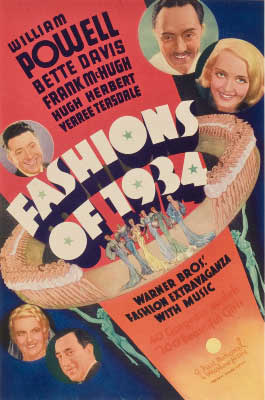
A quickie
from Warner Brothers that tops out at 78 minutes. Most of any credit should
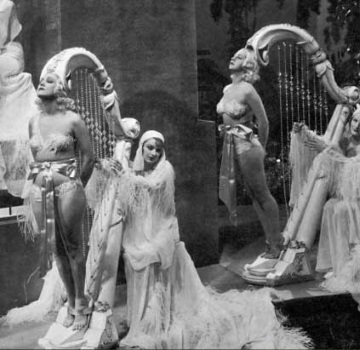
probably go to costume designer Orrey-Kelly who had to come up with dozens
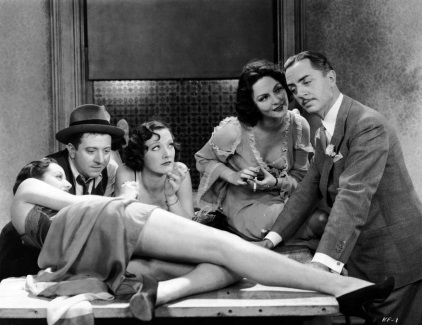
of gowns - and to Busby Berkely who choreographs one big fat musical number
(Spin a Little Web of Dreams) filled with blondes and bare legs. The film
itself is a piffle - slight and nearly pointless. It starts off amusingly
enough but gets more tedious as it goes along. Two big future stars though
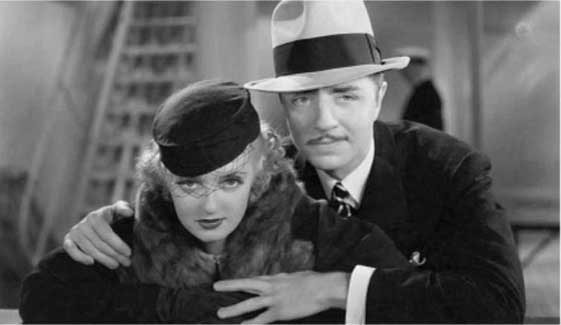
- William Powell a year before the Thin Man and Bette Davis months before
Of Human Bondage. For Powell this was just practice for his Thin Man character
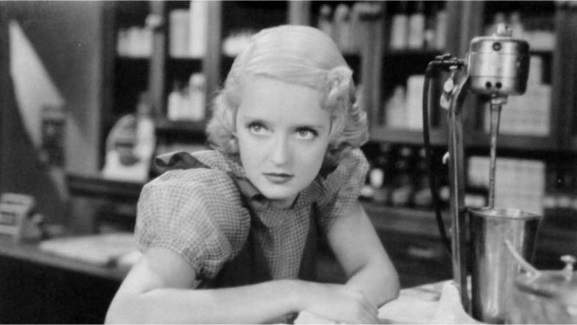
- suave, charming, fast-talking - but for Davis it was hell. She hated being
in this film. She so wanted to be taken seriously as an actress and this
film wasn't it.
Davis loved performing in theater. She loved
the applause, the immediate payback. As a teenager her mother had brought
her to an Ibsen play and Davis was bedazzled. After the play she told her
mother, that she would become an actress. Not one to smother her daughter's
dream, the mother encouraged her, got her acting lessons and introductions
to producers. And within a fairly short period of appearing in plays - once
she was an usher and got a chance to play a role when the actress got sick
- right out of a movie plot - she was an upcoming star, getting great reviews
and ovation after ovation. She was a natural. Then as was the case, along
came Hollywood looking for theatrical talent with the move into sound. Her
first audition was a big zero, but then Universal offered her one. The owner
of Universal Carl Laemmle wasn't impressed, but the camera man told him to
hire her based on her eyes. Universal stuck her in a few bad films with small
parts and she was ready to return to the theater. Universal did not renew
her contract.
Then she got a call from George Arliss -
acting royalty at the time - saying he had heard about her from a fellow
actor and wanted to see if she would audition for a new film. She initially
thought it was a prank, but he convinced her to come down. She did - he looked
at her - asked a couple questions and told her she was hired. She plays his
much younger protégé who loves him. Arliss was with Warners
and the film did quite well and Davis is great in a small but important role.
Warners signed her. And then proceeded to cast her in a bunch of lousy
roles. They had no idea what to do with her - mousy roles, sister roles -
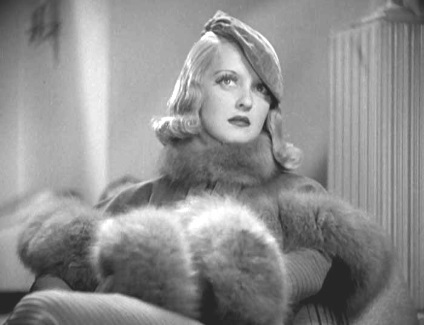
and then in Fashions of 1934 they decided to make her into a glamorous actress
with her hair platinum blonde and made up to the gills.
She actually pulls it off, but she hated
it. "Look at me in this picture all done up like a third-rate imitation of
the MGM glamour queens." She heard that RKO was producing Of Human
Bondage and were having trouble finding an actress to play the nasty, conniving
main character. She begged Jack Warner to loan her out, but he refused -
kept bugging him till they made a trade, Davis for this film and RKO sent
over Irene Dunne for a film. Davis hired a Cockney servant to learn the accent
- it was more a critical hit then an audience one. Her character is vile
and cruel to Leslie Howard of all people. Life magazine wrote "probably the
best performance ever recorded on the screen by a U.S. actress".
In this film, Powell plays a quick-thinking
con man always with a scheme up his sleeve. When he meets Davis who wants
to be a fashion designer he instantly thinks of one. Get an early look at
Paris fashions right off the boat and make pirated copies to be sold at discount.
Davis draws up the designs. They get caught but then he strikes a deal with
the fashion houses that he will go to Paris and do the same - send them the
drawings. Along with him is Davis and Warner stalwarts Frank McHugh and Hugh
Herbert. It just doesn't amount to much - there is zero chemistry between
Powell and Davis and when it finally turns to love it feels like an afterthought.